 Ironstone
Yes, selling websites to local businesses can work. It works best when you sell a finished website the owner has already seen, not a promise. Many local businesses still have no website, or one that fails on a phone, and many pay someone else to build it. It fails when people pitch before they build, message hundreds of strangers, or stop after a week. This guide is honest about both sides. It ends with a 30-day test you can run in your own town. It doesn't promise results.
Key facts
- In Clutch's 2025 survey, 45% of small business websites were built by outside partners, more than by in-house teams or by the owners themselves. 1
- In Clutch's 2025 survey, 17% of small businesses still had no website, and over a third of those said a website isn't relevant to them. 1
- Of 460 local businesses that Lead finder, our business lookup tool, checked for partners between October 19 and November 6, 2026, in 6 towns and 30 business types, 85 had a gap an owner can see, such as no website it could find or an outdated one. 2
- The FTC's compliance guide to the CAN-SPAM Act says a commercial email needs your postal address and a clear way to opt out, and opt-out requests must be honored within 10 business days. 3
Does selling websites still work in 2026
Yes, it still works: the need is there, and many owners hand the job to someone else rather than build their own. The real question behind the search is whether owners still buy websites when they could build one themselves, and the figures below answer it. Whether it works for you depends on how you sell. That's what the rest of this guide covers.
of small business websites are built by outside partners, in Clutch's 2025 survey, more than by in-house teams or by owners themselves. Owners who could build their own often don't. 1
of small businesses still had no website, in the same Clutch survey. Over a third of those say a website isn't relevant to them, so part of the job is showing them why it is. 1
of 460 local businesses that Lead finder, our business lookup tool, checked for partners between October 19 and November 6, 2026 had no website it could find, an outdated one, a social listing only or a delivery page only. The gaps are real but spread out, which is why a short, well-chosen list matters more than a long one. 2
In the same checks, many businesses already had a working website. So this isn't a business where every door says yes. It's one where the right door often does, when you walk up with a finished website in your hand. That's why picking the door matters so much.
Why selling websites to local businesses works
It works because of how local owners decide: they're busy, they like dealing with people nearby, and they think in customers, not pages. Very little of that has to do with design. Here's what it looks like.

- Customers look a business up before they call, and owners know it.
- Many owners have no time to build or update a website themselves.
- A finished website of their own business is easy to judge in minutes.
- A monthly price is small next to what one new customer is worth.
- Owners would rather call a local person than a company far away.
- Happy owners tell other owners, so one client can lead to the next.
Tip
Owners buy the person as much as the website. Being local, polite and quick to make changes counts for a lot.
Why it fails for many people
It fails for many people because of the same few habits: pitching a website that doesn't exist yet, mass messages, the wrong businesses and no follow-up. None of them is a lack of demand, and each one can be fixed. The 30-day test below is built to avoid every one of them. Read the list and be honest about which ones sound like you.
- Pitching a website that doesn't exist yet and asking the owner to imagine it.
- Sending the same message to hundreds of businesses at once.
- Choosing businesses that already have a good website of their own.
- Talking about design and technology instead of the owner's customers.
- No follow-up at all, or far too many follow-ups.
- Stopping after one quiet week, before the second messages land.
- A price the owner can't repeat in one sentence.
Notice that none of these is about skill with code. They're about choosing the right businesses, showing something finished and following up once. Anyone can learn those. It does take work, though, and many people stop before they've given it a fair test.
What AI changed about selling websites
AI changed the order: a finished website takes minutes to build from the business's own listing and current website, so you can build first and sell second. The old way made you sell before you built, because a website took days or weeks and nobody built one before a yes. Now the owner judges something real, not a sketch or a promise.
Here's what we see on our live service. Between October 21 and November 3, 2026, 16 of 18 builds finished in under three minutes. The slowest took about nine and a half. The build is no longer where your time goes. It goes into the people part.
| Step | The old way | Building first with AI |
|---|---|---|
| When you build | After the owner pays a deposit | Before the first conversation |
| What the owner judges | A pitch, a portfolio and a promise | Their own finished website on their phone |
| Time to build | Days or weeks of back and forth | Minutes, from what the business published |
| How they pay | A large one-time bill | A monthly price after they approve |
| After it's live | The owner is often on their own | Changes in plain words, every month |
The build stopped being the hard part. What still takes a person is choosing the businesses, showing the website, asking for the yes and looking after the client. In short, the sale is the skill now. It's also one you get better at with practice.
How to test it in your town in 30 days
Seven steps over about a month tell you whether this works for you. You'll have your own numbers instead of someone else's claims. The steps follow our full guide to selling AI websites to local businesses, cut down to a test.
1. Pick a business type where the gaps are
A test on the wrong business type tells you nothing about the idea. If no one in that type needs a website, a quiet week proves nothing. So pick a type where many businesses have a gap you can see. Then a quiet week means the method needs work, not the market. That's a lesson you can act on.
Search the type and your town in Google Maps. Look at the first twenty listings and count the ones with no Website button. Write that number down. Then look up how many businesses of that type your county has in the Census Bureau's County Business Patterns. Both counts go in your sheet.
Here's the part many people miss. Check Google Trends for the type in your state. A type whose busy season is coming, such as heating repair before winter, gets a faster answer than one in its quiet months. Timing counts for more than you'd think.
- One business type and one town for the whole test.
- At least five of twenty listings show a gap.
- Enough businesses of that type in your county.
- Its busy season is coming, not ending.
- A town you can visit in person.
You know this step worked when you can name your type and town in one sentence and say why. The counts from Google Maps and County Business Patterns are written in your sheet, ready to compare later.
Tip
Pick a type you'd be glad to visit for a month. A test you dread stops early, and a test that stops early proves nothing.
2. Build five websites before you call anyone
The test is whether owners buy a finished website. So the websites have to exist before the first conversation. If you show up with nothing, you're testing a pitch, not the idea. Five is enough to learn from. It's also few enough that you can check every fact on every page yourself.
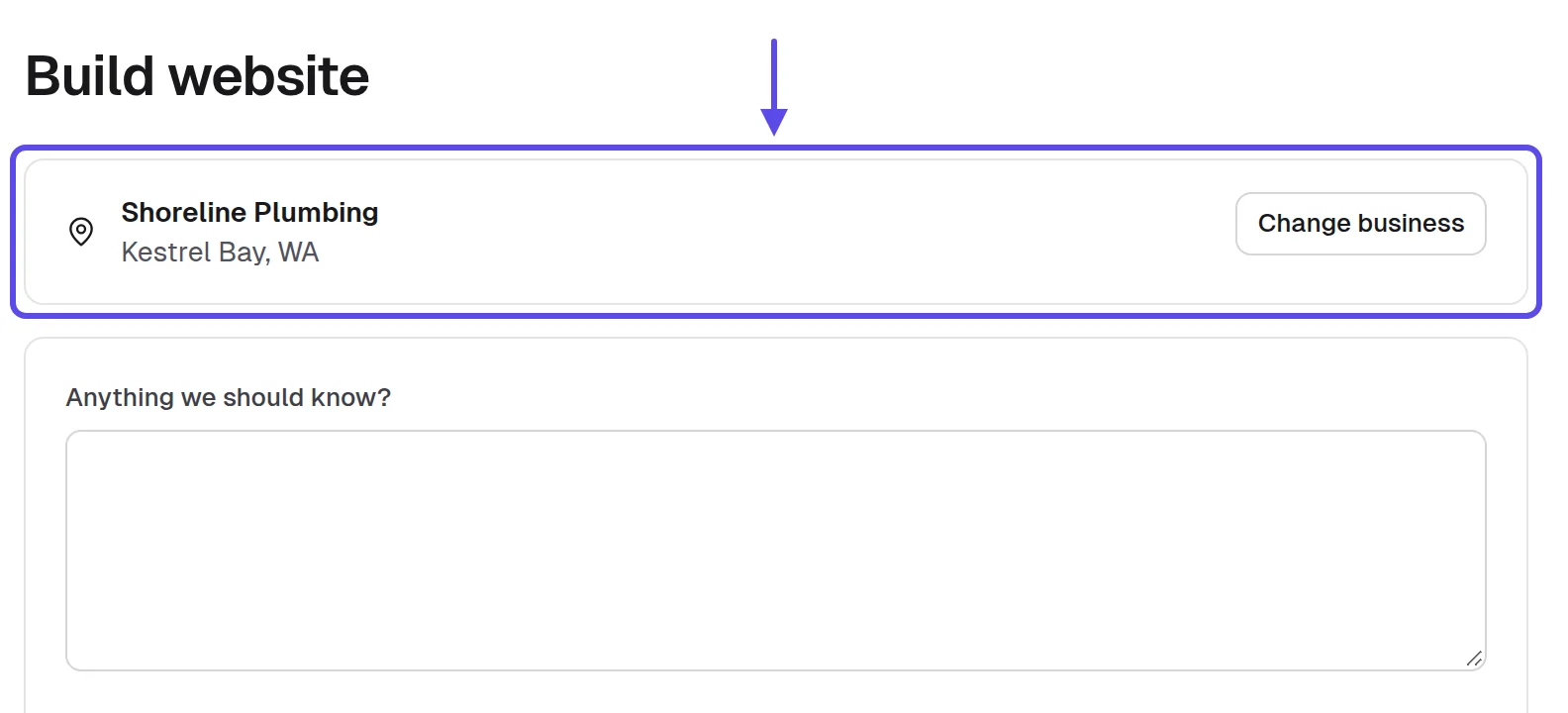
Find your five with Lead finder or by hand from your Google Maps count. Then build each one from its listing and current website. Read every fact against what the business published. If anything's wrong, fix it in plain words before anyone sees it.
The twist is to build for the customer the owner wants more of. A plumber wants emergency calls, so the call button goes at the top. A bakery wants orders, so the menu comes first. Ask yourself what a good day looks like for that owner.
- Five active businesses, all of one type.
- Every fact matches what the business published.
- The call button works from a phone.
- Nothing on any website was made up.
- Each website opened on your own phone.
You know this step worked when all five websites are marked Ready to send. You'd also be glad for each owner to see theirs on their phone today, with no fixes left to make.
Tip
Pick five businesses a short drive from each other. Then the visits in step 3 fit into one afternoon instead of five.
3. Show them in person first
Showing the website in person is the clearest test. You see the owner's face when they scroll their own website. An email with no answer tells you nothing. A visit tells you what they liked and what stopped them, in a few minutes. That's worth more than a week of guessing.

Open with one thing a customer can't do today, such as find the hours, and show it working. Talk about their customers, not about AI. Before you go, leave the link so they can show their staff. Owners often want a second opinion.
What to say first
I searched for a plumber in town and couldn't find your hours or a number to tap, so I built your business a website that has both. I'd like to show it to you on your phone.
It's already built, and there's nothing to pay to look at it. If you like it, it can be live this week.
- Visit at a quiet hour, not at lunch.
- Show it on their phone if they agree.
- Start with what customers can't do today.
- Write down what they liked and what stopped them.
- Agree on a day to follow up.
You know this step worked when, after five visits, you have notes in their own words. You know what owners liked about their websites and what held them back. Those notes shape every message you send next.
Tip
Write your notes in the car right after each visit, before the next one. The owner's exact words fade fast, and they're the most useful thing a visit gives you.
4. Send the rest with a personal message
For businesses you can't visit, send one short personal message each, with their own link. Our app writes a first message in your name. You can send it by email or text, or print a flyer instead. Every email carries your postal address and a clear way to opt out.
In the United States, the FTC's compliance guide to the CAN-SPAM Act says a commercial email must include your valid physical postal address and a clear way to opt out, and opt-out requests must be honored within 10 business days. 3
The twist: record a short screen video with Loom that scrolls their website on a phone. Say the business name in the first five seconds. Owners open a video about their own business, because it's about them. Keep it short and put the link in your message.
First email to an owner
Subject: A website made for [Business name]
Hi [Owner name],
I'm [Your full name] from [Your business name]. I looked for [Business name] online and couldn't find a number to tap, so I built a website for you to see.
Here's the link, and it works on a phone: [Website link]
If you want it, I can put it live and look after it for you every month.
If you'd rather not hear from me, reply "no thanks" and I won't write again.
[Your full name], [Your business name], [your mailing address]
First text message
Hi, this is [Your full name] from [Your business name], [your phone number], [your address]. I built a website for [Business name] so your customers can tap to call you. Here's the link: [Website link]. Reply STOP to opt out.
- One business, one message, their own link.
- Your name, business name and postal address.
- A clear way to say no thanks.
- No bought lists, no mass sends.
- The send date written in your sheet.
Tip
Send each message at an hour the owner is likely to read it, such as a quiet mid-morning. A message that lands during the lunch rush gets buried under the day's orders.
5. Follow up once and offer a short call
Many replies come from the second message, not the first. Owners are busy, and a first email gets buried. If your test skips the follow-up, it undercounts what works. One follow-up a few days later is normal and polite. More than that starts to feel like pressure, and owners remember it.
The twist is to make the next step small. A Calendly link lets the owner pick a ten-minute call at a time that suits them. That's easier to say yes to than asking whether they're interested. A short call feels like a favor, not a commitment.
The follow-up email
Subject: Re: A website made for [Business name]
I wanted to check that you saw the website I made for [Business name]. Here's the link again: [Website link]. If it helps, you can pick a ten-minute call here: [Booking link]
Reply "no thanks" and this will be my last message.
[Your full name], [Your business name], [your mailing address]
- One follow-up, three to five days later.
- The same link, with any change they asked for.
- A booking link for a short call.
- Stop at any no, right away and politely.
- Every reply noted the same day.
You know this step worked when some owners answer the second message after ignoring the first. You also know which message each reply came from, because you wrote it in your sheet.
Tip
Mention the change they asked for, or one thing on their website, in the follow-up. It shows the message was written for them, not copied to a list.
6. Ask for the yes
The test ends with owners deciding, not with owners liking it. When an owner says they like it, send the approval link while you're still talking. Paying is their approval of the exact website they saw. It goes live in a few minutes, so they can see the result right there.
Decide your monthly price before the first visit, using our guide on what to charge. Say the price once and say what it covers. Then stop talking and let the owner answer. The quiet feels long, but it's their turn to decide.
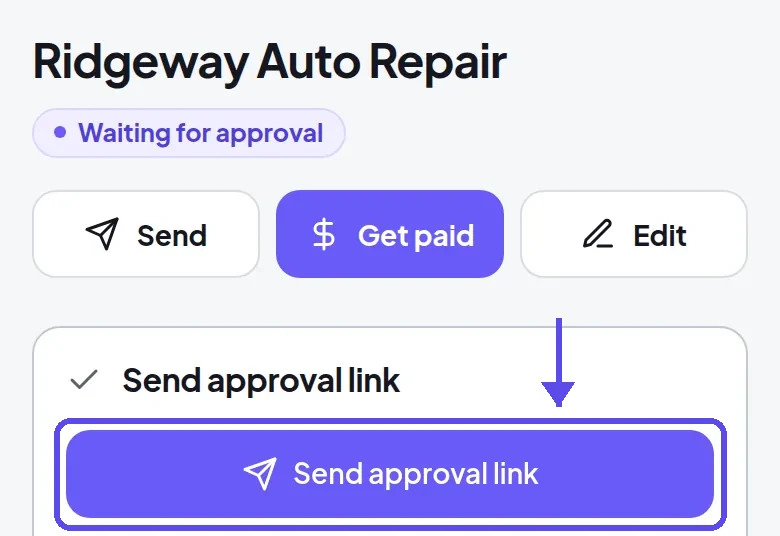
The approval message
Thanks for your time today. Here's the link to approve [Business name]'s website: [Approval link]. It shows the website and the monthly price we agreed, and once it's approved, it goes live within minutes.
- Your price decided before the first visit.
- The link sent while the yes is fresh.
- The price on the page matches what you said.
- Every no written down with its reason.
- Thank every owner, whatever they decide.
You know this step worked when every owner you showed has one of three things in your sheet. That's a yes, a no with a reason, or a date to decide. Nobody is left as a maybe.
Tip
Have the approval link open on your phone before you walk in. Searching for it while the owner waits lets the moment cool.
7. Count what happened
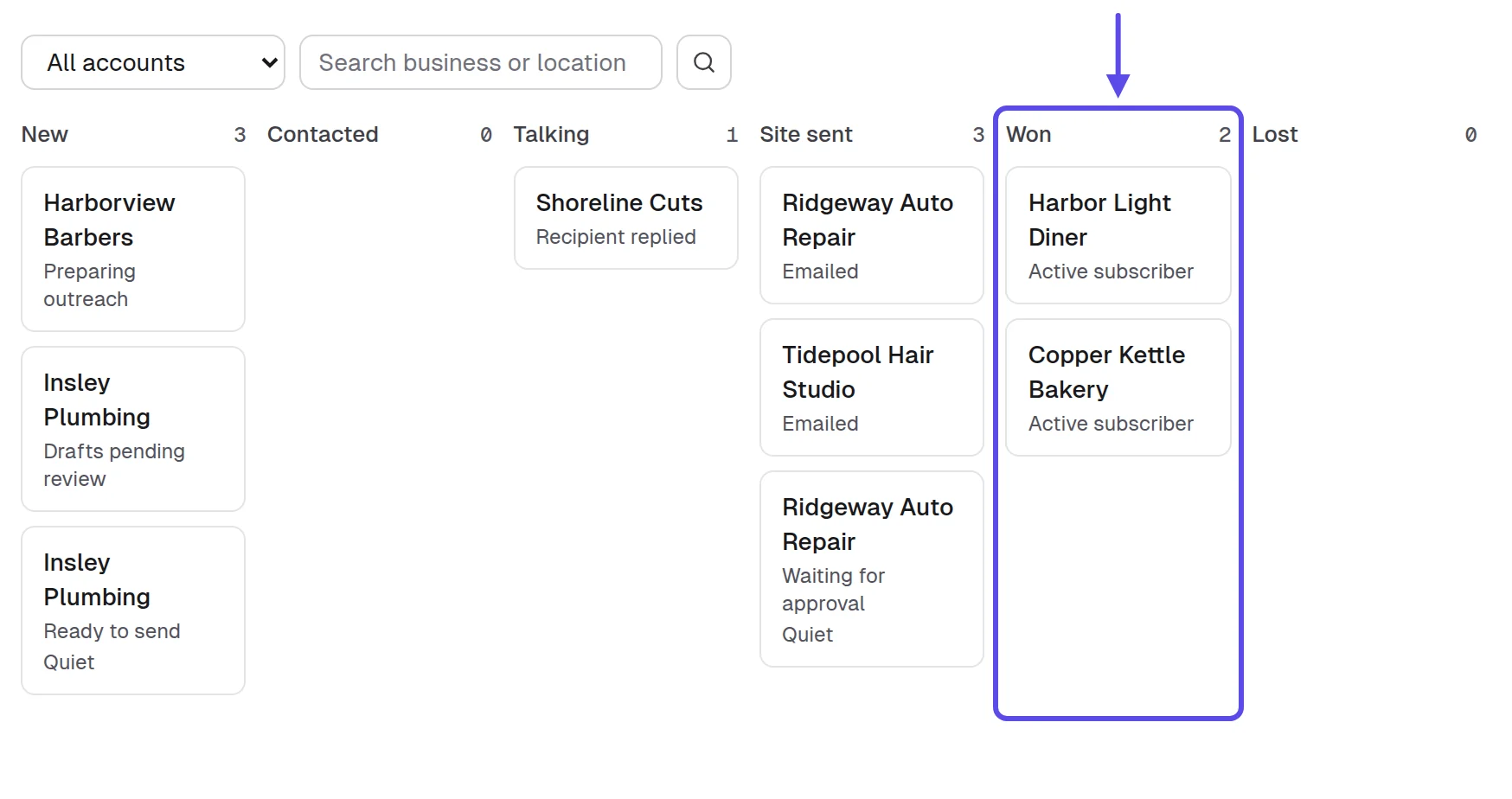
A month of notes beats any opinion, yours or anyone else's. Keep one row per business in Google Sheets or the Pipeline in our app. Write the date, how you reached them and what happened. Do it the same day, while you still remember what the owner said.
Your tracking sheet
Business, Type, Town, Gap, Date built, How reached, Date contacted, Replied, Follow-up date, Shown, Decision, Reason, Next step
Look at where the numbers drop, not at the totals. Few replies points to the list or the message. Replies but no yes points to how you show it or the price. A yes followed by a cancel points to the care after the sale.
- One row per business, written the same day.
- How each owner was reached, in person or by message.
- The reason behind every no, in their words.
- The step where businesses stopped moving forward.
- One change to try next month.
You know this step worked when you can say, from your own sheet, where your method works and where it breaks. You can also name the one thing you'll change in the next 30 days.
Tip
Write down how each conversation felt, too. The kind of visit or message you dread is often the step to change first.
Does cold outreach work for selling websites
Cold outreach works when it's one personal message to one business, with a website already built for them, their own link and an easy way to say no. A generic email sent to hundreds of strangers rarely works, and it can break the law. A personal message like that often gets read.
The difference is that the owner can check your claim in five seconds. "I couldn't find your hours, here's a website that shows them" is a fact about their business, not a pitch. Always include your postal address and an opt-out, and stop at any no.
A direct message
Hi, I'm [Your full name] from [Your business name]. I made [Business name] a website because your page doesn't show a number to tap. Here it is: [Website link]. I'm glad to show you in person, with no pressure at all.
Signs to keep going or change course
After 30 days, your sheet usually points one way. The signs below tell you which. They're signals, not targets, so don't look for a number to hit. Look for patterns in what owners did and said.
- Keep going: owners scroll their website and point at things they like.
- Keep going: replies arrive after the follow-up you sent.
- Keep going: owners ask about the price or the domain.
- Change course: owners can't see the gap you picked.
- Change course: no one replies to the message, even after a follow-up.
- Change course: owners like it but say no to the price.
If you need more owners to show, our guide on how to get web design clients faster has a two-week plan. If owners doubt the website itself, the honest case for why a small business needs a website helps you answer them.
Frequently asked questions
Is selling websites to local businesses still worth it?
It can be, when you sell finished websites to businesses with a visible gap and look after them every month. Nothing here promises a result. Run a 30-day test in your own town, with one type of business, and let your own numbers decide whether to keep going.
Do AI websites actually sell?
Yes, when the owner sees a finished website for their own business on their own phone. Owners don't buy "an AI website"; they buy a website that looks like their business and works. AI makes the build fast, so you can show the finished thing first, and you being there to answer questions does the rest.
Does cold outreach work for selling websites?
Mass messages to strangers rarely do. One personal message often gets read when it has a website already built for that business, their own link, your postal address and an easy way to say no. A visit in person works better still, because the owner sees it on their phone.
How long does it take to get a first client selling websites?
No one can promise a time, and we don't publish one: it varies with the town, the business type and how many owners you show. A 30-day test with one type and one town is long enough to see whether owners in your town say yes. It also shows you what to change.
What's the hardest part of selling websites to local businesses?
The sale, not the build. Choosing the right businesses, showing the website in person and following up once take more time than building. They're also what you get better at, month after month, as your notes grow. So that's where your effort should go.
Do I need to be technical to sell websites?
No. The website is built from the business's own details, and you change it in plain words. What matters is being clear, local and quick to help when an owner asks for something. Owners care that the website works and that you answer the phone.
Sources
- Clutch, “83% of small businesses now have a website” (press release, August 21, 2025)
- Ironstone, Lead finder’s checks for partners, October 19 to November 6, 2026: 460 local businesses in 6 towns and 30 business types, from our own records read November 10, 2026
- Federal Trade Commission, CAN-SPAM Act: A Compliance Guide for Business