 Ironstone
The clients easiest to find are local businesses with a website problem the owner can see. No website, one that won't open, or one that fails on a phone. Search one business type in your town, check each listing, and start with the active businesses. Then add the people you already know, local businesses that serve the same owners, and referrals from happy clients. This guide walks through eight ways to do it, with the messages to send and how to tell which one works for you.
Key facts
- Between October 8 and November 6, 2026, 54 searches in Lead finder, our business lookup tool, by 7 partners returned 735 local businesses, by Ironstone's own records with our own accounts left out. 3
- The US had 8.3 million businesses with paid employees in 2022, according to the Census Bureau's 2022 County Business Patterns. 4
- In October 2025, the Internet Archive's Wayback Machine passed one trillion web pages preserved. 5
Where web design clients come from
Web design clients come from Google Maps searches, websites that need fixing, people you already know, partner businesses, local events and referrals: the eight ways in this guide. Many small businesses pay someone else to build their website, so the work is out there; the question is where those owners are and how they'd hear about you. The three figures below are Clutch's 2025 survey of who builds small business websites, a dated count of businesses with a gap from Lead finder, our business lookup tool, and the Census Bureau's 2022 count of employer businesses.
of small business websites are built by outside partners, according to Clutch's 2025 survey, more than by in-house teams or by the owners themselves. Many owners hand this job to someone, and the question is whether that someone is you. 1
Lead finder, our business lookup tool, showed 6 partners 56 local businesses with a gap an owner can see between October 8 and November 17, 2026, with our own accounts left out: 28 no website found, 16 an outdated website, 6 only a social or directory page, 6 only a booking or ordering service. These are the businesses with a gap you can name to the owner, and each label is a reason to call. 3
The Census Bureau's 2022 County Business Patterns, in a story of May 6, 2025, found "there were 8.3 million U.S. employer businesses" with paid employees in 2022. You need only the few in your own town and business type that need a website. 4
So the gaps are real, but they sit in some businesses and not others. That's why a method beats luck. Pick one type in one town, build a short list, and have a clear reason to call each business. Then every call starts with something the owner can check for themselves.

Tip
A business with a working, current website isn't your client this month. Leave it and move on to the next listing.
The best places to find web design clients
Here are the eight ways in this guide, in the order they usually pay off when you're starting out. The first four find businesses with a gap. The last four bring the owners to you instead.
- Google Maps searches for one business type in your town, one listing at a time
- A quick check of the websites that exist, for age and speed on a phone
- Lead finder, which labels every business in a town by its website problem
- A count of every business of your type in your county
- The people you already know, and the business owners they know
- Local businesses that serve the same owners, such as accountants and sign shops
- Places where owners meet in person, such as business groups and markets
- Referrals from clients who are happy with their new website
How to find web design clients in 8 steps
Each step below is one way to find owners, with a template and a checklist. Once you have a list, the whole method for selling AI websites to local businesses takes it from there: build the website, show it to the owner, and get paid.
1. Search Google Maps for businesses with no website
Customers find local businesses on a map, so that's where a missing website shows. A listing with no Website button is a gap the owner can see on their own phone in five seconds. Nothing else gives you such a clear reason to call, because you aren't guessing at a problem.
Search "[business type] near [town]" in Google Maps and open each listing. No Website button, or a button that opens a social page, is a gap, so copy the name, phone and address into a sheet in Google Sheets with a note on what you found. Stop at ten rows, because a short list is one you'll actually look at with care.
Then zoom the map out to the next town, and the one after that. A business type with many gaps in a smaller town nearby can beat a crowded big town. And it's still local if you can drive there to meet the owner.
- One business type and one town per search
- No Website button, or a social page only
- Reviews from recent months, a sign the business is still open
- Opening hours and a phone number listed on the page
- Name, phone and gap copied to your sheet
You have ten businesses of one type in one sheet. Each one has a gap you could point to on the owner's own phone, and you can say what it is in a few words.
Tip
Search on your phone, not your laptop. You'll see each listing the way their customers do.
2. Check the websites that already exist
A business with an old website is often a better client than one with none. The owner already believes in having a website, and they may already pay for one. What they need is to see the gap: slow on a phone, years out of date, or not opening at all.
Paste the website's address into the Wayback Machine to see how long the site has looked the same. Then run it through PageSpeed Insights to see how it does on a phone. A site that hasn't changed in years and gets a poor phone score is something concrete to show the owner, not an opinion they can wave away with a shrug.
Look at the footer before anything else. If it credits a web designer, someone looks after that site, so leave it and move on. An old copyright year, a dead social link or a security warning is the opening you want.
- The site opens without a security warning
- It's easy to read on a phone
- The hours and phone number are easy to find
- The footer's year and links look current
- No web designer is credited in the footer
Each website on your list has one problem written beside it. It's in words an owner would understand, such as "hard to read on a phone," not in scores or tech terms.
Tip
Take a screenshot of the old website on your phone before you get in touch. If the owner fixes something before you meet, you still have the before picture.
3. Let Lead finder label every business
Lead finder searches a business type in a town and checks each business's website for you. It labels each one by what it found: No website found, Social listing only, Website won't open, Domain parked or Outdated website. Under each label is a line you can say to the owner.
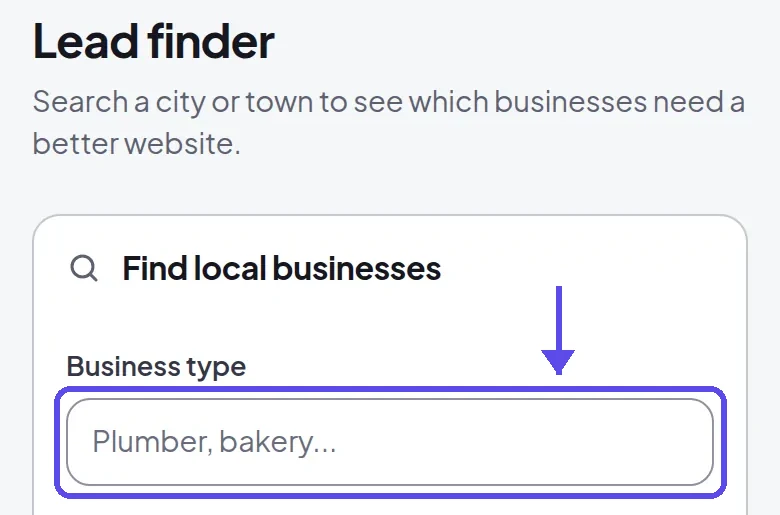
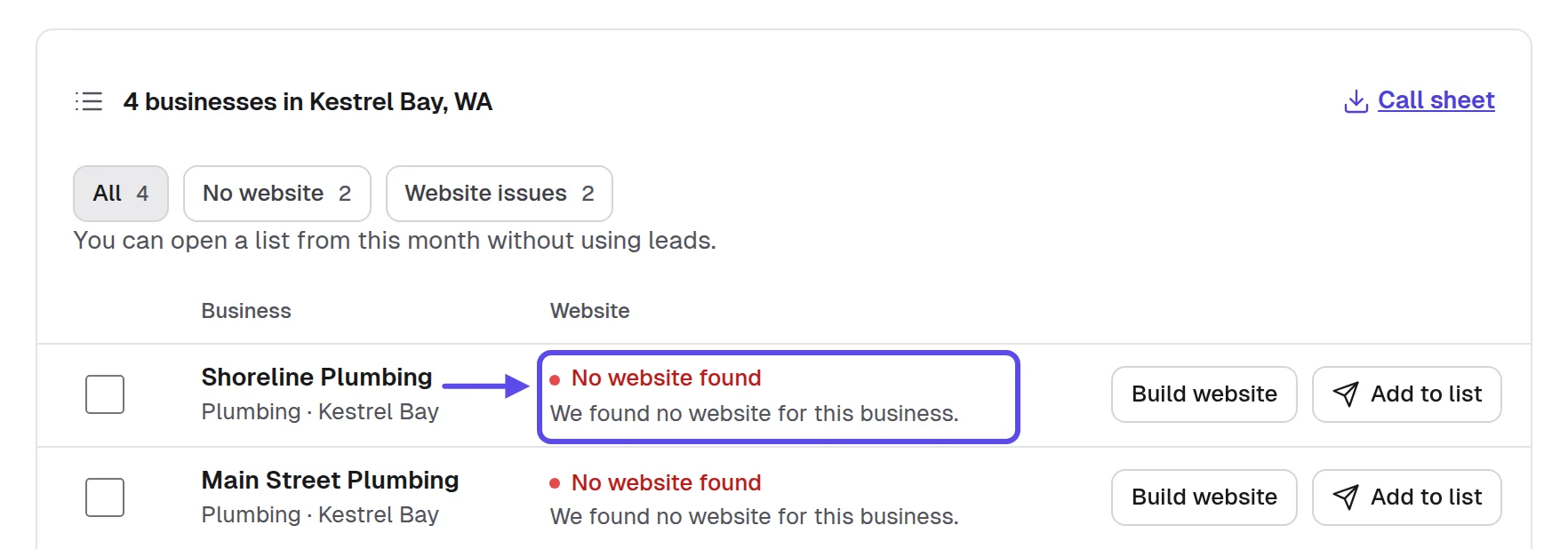
Sort the results by the label, not by the business name. Start with No website found and Website won't open, because those owners see the problem fastest on their own phone. Save Outdated website for later, for when you have a finished website to show them side by side with the old one.
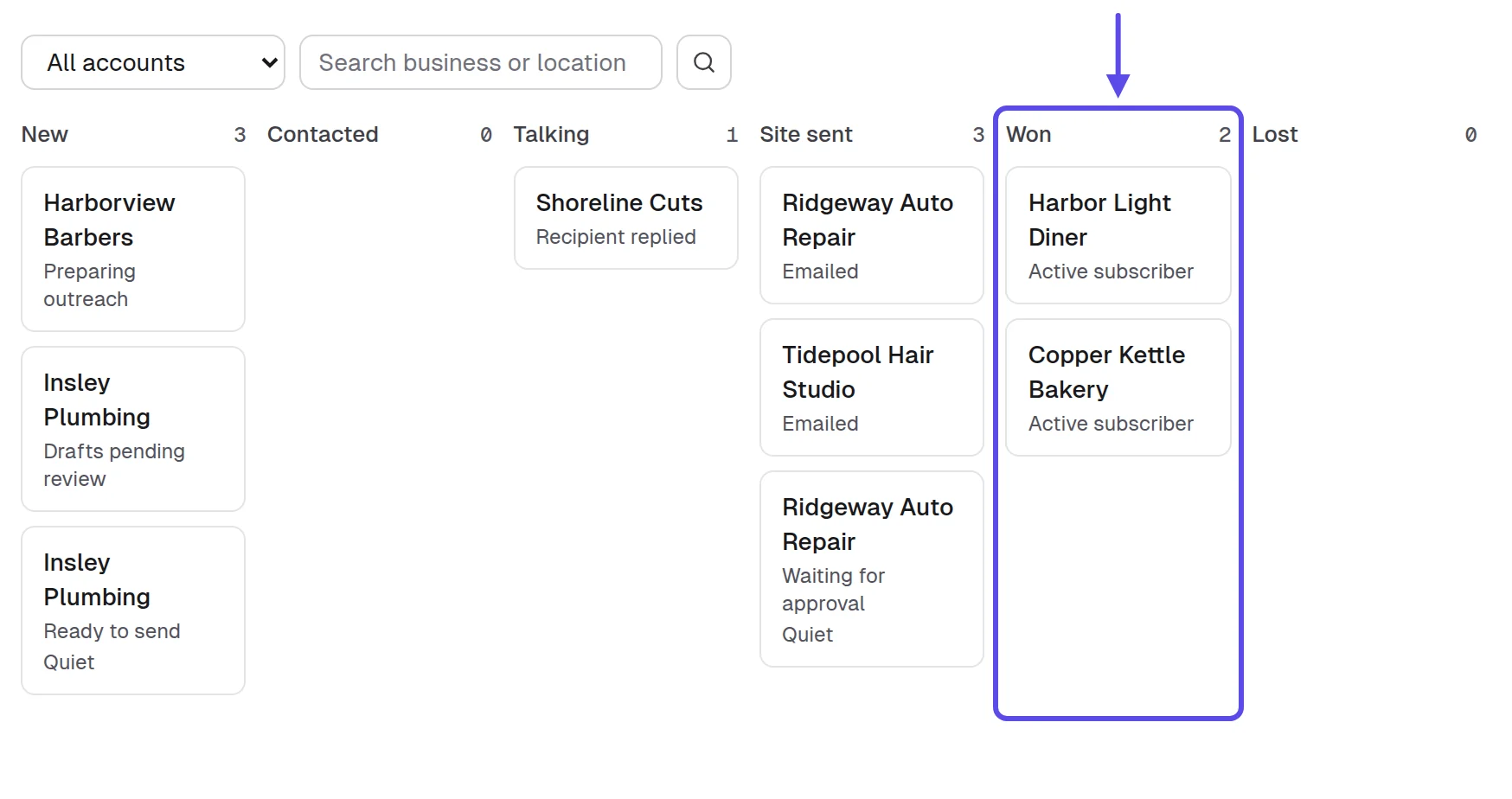
From any result, you can build the business a finished website in a few minutes. A business whose site credits a web designer goes on your call sheet, not to email. Every business you contact moves to the Pipeline, so nothing gets lost.
- One business type and one town per search
- Start with No website found and Website won't open
- Open each result on your own phone first
- Build websites only for active businesses
- Move each business you contact into the Pipeline
You have a short list sorted by label. For each business on it, you can say its problem in one sentence before you pick up the phone or walk in the door.
Tip
Run the same search again a month later. New businesses open and old websites break, so the list keeps changing.
4. Count every business of your type in your county
Before you spend weeks on one business type, check first that there are enough of them near you. A type with only a handful of businesses in your county runs out fast. A type with hundreds of businesses can keep you busy for months, with new gaps to find as you go.
The Census Bureau's County Business Patterns counts businesses by type and by county, every year. Open its data tables and pick your state, then your county. Next, search for the industry by name, such as plumbing or full-service restaurants, and choose the closest match. Find the column that counts businesses, often labeled establishments, and write that number down. The count tells you how big your list can get, before you spend a single hour searching.
Compare two or three types side by side. The type with many businesses in the county, and many gaps in your Google Maps search, is the one to start with. It may not be the one you'd have guessed, and that's fine.
- Your county and two or three business types
- The count of businesses for each type
- How many of your ten had a gap
- A type you could explain in one sentence
- One type chosen to start with this week
You can say how many businesses of your type are in your county. And you chose your first type from numbers, not from a hunch or a guess about what sounds good.
Tip
Use the same county in your Google Maps search, so the two counts describe the same place. A county count beside a city search makes the gap look bigger or smaller than it is.
5. Start with the people you already know
An owner listens to someone they know, or to someone a friend sent. Your friends, family and old coworkers know a hairdresser, a mechanic or a café owner who still has no website of their own. A warm introduction skips the hardest part of this work, which is being a stranger.

Don't ask if they know anyone who needs a website. Ask about one business type, such as a plumber or an electrician they've used. A specific question gets you a name, and a vague one only gets a polite maybe.
A message to friends
I've started building websites for local businesses. I'm looking for [business type] owners in [town] who don't have a website yet. If you know one, I'd be glad of an introduction, and I'll make the website first so the owner can see it before deciding anything. Thanks for thinking of me.
- Ten people who know local business owners
- One business type named in every message
- A website built before the introduction call
- A thank-you to everyone who sends a name
- Every name added to your sheet or Pipeline
You have names you'd never find in a search or on a map. And there's an owner who expects your call, because someone they trust has already mentioned you to them.
Tip
Ask your friend whether you may say their name when you call. Saying who sent you in the first sentence turns a cold call into a warm one.
6. Team up with businesses that serve the same owners
In every town, some local businesses talk to owners every week: bookkeepers and accountants, sign makers, printers and business insurance agents. They hear owners say "we should really get a website" all the time. One friendly partner who trusts you can send you more owners than a hundred cold messages ever will.
Offer them something useful first, not a commission. That could be a simple page for their own business, or a short list of their clients' map listings that show the wrong hours. Never team up with a design or marketing agency, though, because it sells the same thing you do.
Email to a local partner
Subject: Websites for your clients in [town]
Hi [Name],
I'm [Your full name] from [Your business name]. I build and look after websites for local businesses in [town].
Many of your clients may still have no website, or one that's hard to use on a phone. If any of them want one, I'll make it first so the owner can see it before deciding.
I'd be happy to meet for coffee and hear what your clients ask about.
If you'd rather not hear from me, reply "no thanks" and I won't write again.
[Your full name], [Your business name], [your mailing address]
- Three businesses that talk to owners every week
- Something useful to offer them first
- One short email or visit to each
- A thank-you every time they send someone
- No agencies that sell websites themselves
A partner mentions you to an owner without you asking first. Then the owner calls you, and they already know what you do before you say a single word about websites.
Tip
Start with businesses you already use, such as your own accountant. They know you as a customer, and that makes the first conversation easy.
7. Go where owners meet in person
Owners tend to trust a face more than an inbox. Business groups, chamber of commerce breakfasts, farmers markets and trade fairs put twenty owners in one room on the same morning. One conversation with a website already built on your phone does more than any email you could send them later.
The Small Business Administration's local assistance finder lists the small business centers and business groups near you. Many of them hold in-person events where owners go to pick up new skills. That's exactly when owners are thinking about their business, and about what's missing.
Go as a helper, not as someone looking for a sale. Bring your phone with two websites you built for businesses in that town, and ask owners how their customers find them. Then wait, and let them ask what you do.
What to say first
"I'm always curious how customers find a business like yours these days."
"I build websites for local businesses. I looked you up and couldn't find your hours online. I can show you on my phone what that could look like."
- Two local events a month on your calendar
- Two finished websites ready on your phone
- Questions about their customers before anything else
- Names and one note for each owner you meet
- A follow-up message within two days
Owners you met ask you a question about their own website. And you leave the room with names to build for this week, each with a note on what they need.
Tip
Wear a name badge with your business name on it. Owners who were too busy to talk can find you again before the event ends.
8. Ask every happy client for a referral
Owners know other owners: the café next door, the supplier, the friend with a salon. When an owner hears about you through word of mouth from a happy client, that's the source they trust above all others. It also costs you the least, because there's no search and no cold message.
Ask right after a good moment, such as the first change you make for them on the very same day they ask. At the same time, help them put the new website on their Google Business Profile, so customers find it too. A happy owner remembers who helped them get found.
This is word-of-mouth marketing, and it works best when you ask about one specific type of business, not anyone at all. Ask who they buy from, or who's next door. Keep it a plain statement, like "I'd love to build for whoever runs the shop next door."

Asking for a referral
I'm glad the new website is working for [Business name]. I'm looking for one or two more local businesses to build for, like the shop next door or one of your suppliers. If you mention me, I'll make that business a website first so they can see it before deciding. Thanks either way.
First email after a referral
Subject: [Client name] suggested I write to you
Hi [Owner name],
I'm [Your full name] from [Your business name]. [Client name] suggested I get in touch, because I made their website.
I've made a website for [Business name] so you can see it first. Here's the link: [Website link]
If it isn't for you, reply "no thanks" and I won't write again.
[Your full name], [Your business name], [your mailing address]
- Ask within a week of the website going live
- Name one type of business to ask about
- Help with their Google Business Profile at the same time
- Build the referred business a website first
- Thank the client, whatever happens next
New owners call or reply mentioning your client by name. Your list grows without a single search, and each new name arrives through someone the owner already knows and trusts.
Tip
Ask for the referral in person or on a call, not by email. A question asked face to face gets a real answer, and an email gets put off.
How to reach the businesses on your list
A list only helps once you contact it. The best first contact is a visit or a call with the website already built. When you can't visit, one personal email or text per business, with its own link, beats any mass message. Our app writes that first message in your name, and you can send it by email or text, or print a flyer.
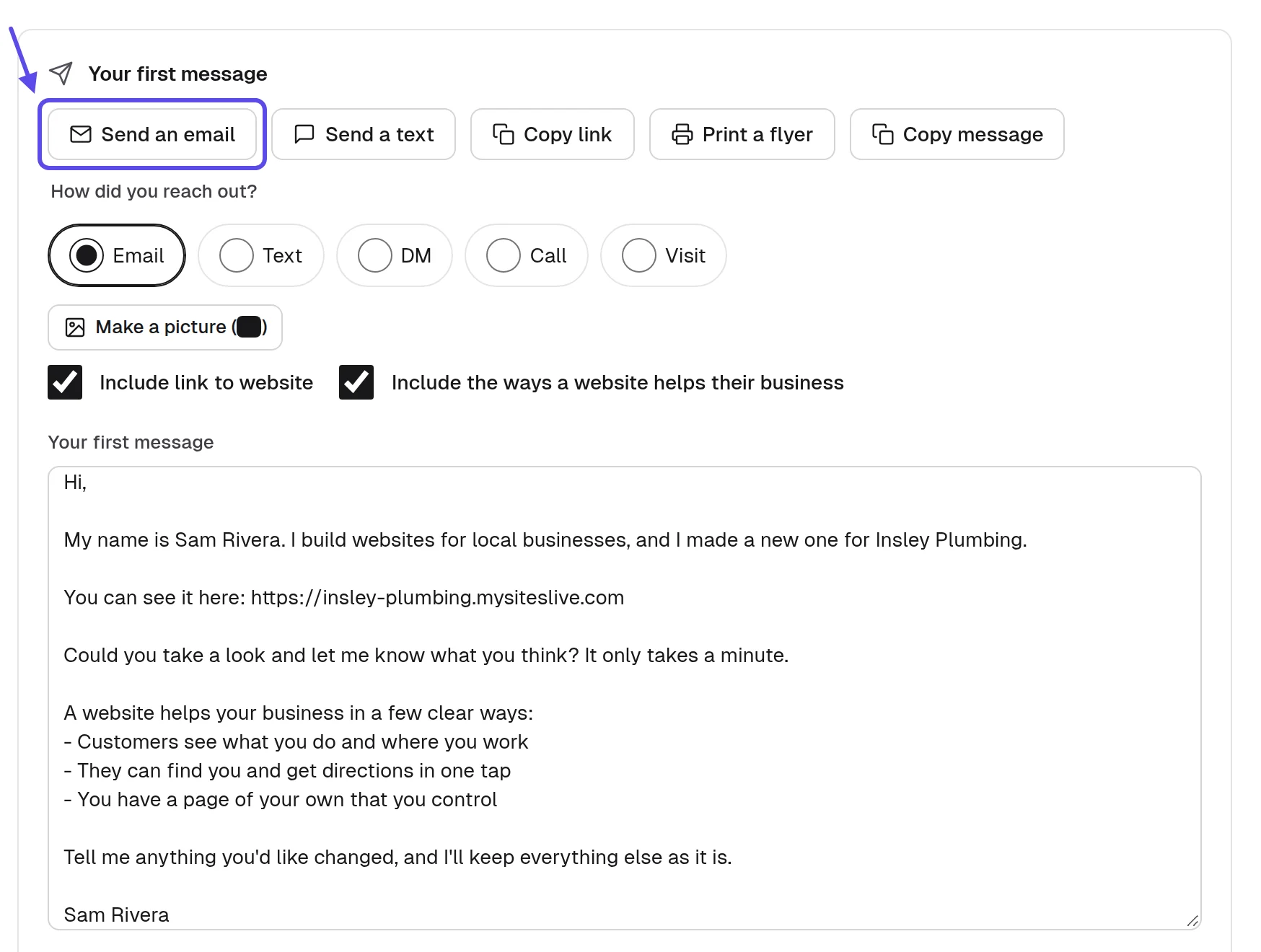
In the United States, the FTC's compliance guide to the CAN-SPAM Act says a commercial email must include your valid physical postal address and a clear way to opt out, and opt-out requests must be honored within 10 business days. 2
First email to an owner
Subject: I made a website for [Business name]
Hi [Owner name],
I'm [Your full name] from [Your business name]. I looked for [Business name] on the map and couldn't find a website, so I built one for you to see.
Here's the link, and it works on a phone: [Website link]
If you want it, I can put it live and look after it for you every month.
If you'd rather not hear from me, reply "no thanks" and I won't write again.
[Your full name], [Your business name], [your mailing address]
First text message
Hi, this is [Your full name] from [Your business name], [your phone number], [your address]. I couldn't find a website for [Business name] on the map, so I built one for you to see: [Website link]. Reply STOP to opt out.
Tip
One personal message to one business beats a hundred copies of the same one. Owners can tell the difference.
Where not to look for clients
Don't start on freelance marketplaces, chains, bought email lists or ten business types at once: they waste your first weeks on the wrong people. Skip these until you have a few clients and a method that works for you. Until then, your time goes further on the eight ways above.
- Freelance marketplaces, where you compete with strangers on price, not on a finished website
- Chains and franchises, because head office decides the website, not the local owner
- Businesses whose footer credits a web designer who looks after the site
- Businesses with no reviews or hours in months, which may have closed
- Bought lists of email addresses, which the owners never agreed to
- Ten business types at once, so you never get to know any of them well
How to tell which place is bringing you clients
Each week, count four things in your sheet or the Pipeline. These aren't targets, and there's no number to hit. They're things to count, so you can see which way of finding owners is worth more of your time as the weeks go by.
- Businesses found: how many active businesses with a gap you add each week
- The source: which of the eight ways each business came from
- The reply rate: how many owners answer your first message or visit
- The yes rate by source: which ways bring owners who approve their website
After four weeks, look at your notes. Drop the way that brought no replies and put that time into the one that did. Then move on to the next place on this list. Don't go hunting for a new method. The one that's working already does its job, so give it more ground to cover.
Tip
Write the source next to every business on the day you add it. A month later, you'll know where your clients really come from.
Frequently asked questions
How do web designers find clients?
Many start with local businesses that have a visible website problem, found on a map or with Lead finder. Then they add people they know, local partners and referrals. Once a few clients are happy, the steady clients tend to come from referrals.
Where can I find local businesses that need a website?
Search one business type in your town on Google Maps. Look for listings with no Website button or a social page only, and note the name and phone. Lead finder does the same check across a whole town and labels each business by its problem, so you know what to say.
Should I target businesses with no website or an old one?
Both are worth your time. A business with no website has the bigger need, but an owner with an old site already believes in having one. So a better version on their phone can often be the shorter conversation of the two.
Is cold email a good way to find web design clients?
One personal email to one business can work, if it has a website already built for them and a clear way to say no. Mass emails to bought lists don't. In the US, every commercial email also needs your postal address and a way to opt out. 2
How many businesses should I contact each week?
Contact enough businesses that you can build for each one and follow up once. Ten a week of one business type is a good place to start. A short list you look at with care beats a long one you never finish.
Do I need a portfolio to find web design clients?
No. The website you build for the owner is your portfolio, because they see their own business finished, with their name on it. Once you have a list, decide what to charge before the first call, so you're ready when they ask.
Sources
- Clutch, “83% of small businesses now have a website” (press release, August 21, 2025)
- Federal Trade Commission, CAN-SPAM Act: A Compliance Guide for Business
- Ironstone, Lead finder’s searches and results for partners (our own accounts left out), October 8 to November 17, 2026, from our own records read November 20, 2026
- US Census Bureau, “Census Bureau Statistics Shed Light on Self-Employment by Sector and State During Small Business Week” (May 6, 2025), on the 2022 Nonemployer Statistics and County Business Patterns
- Internet Archive, “One Trillion Web Pages Archived: Internet Archive Celebrates a Civilization-Scale Milestone” (October 31, 2025)